
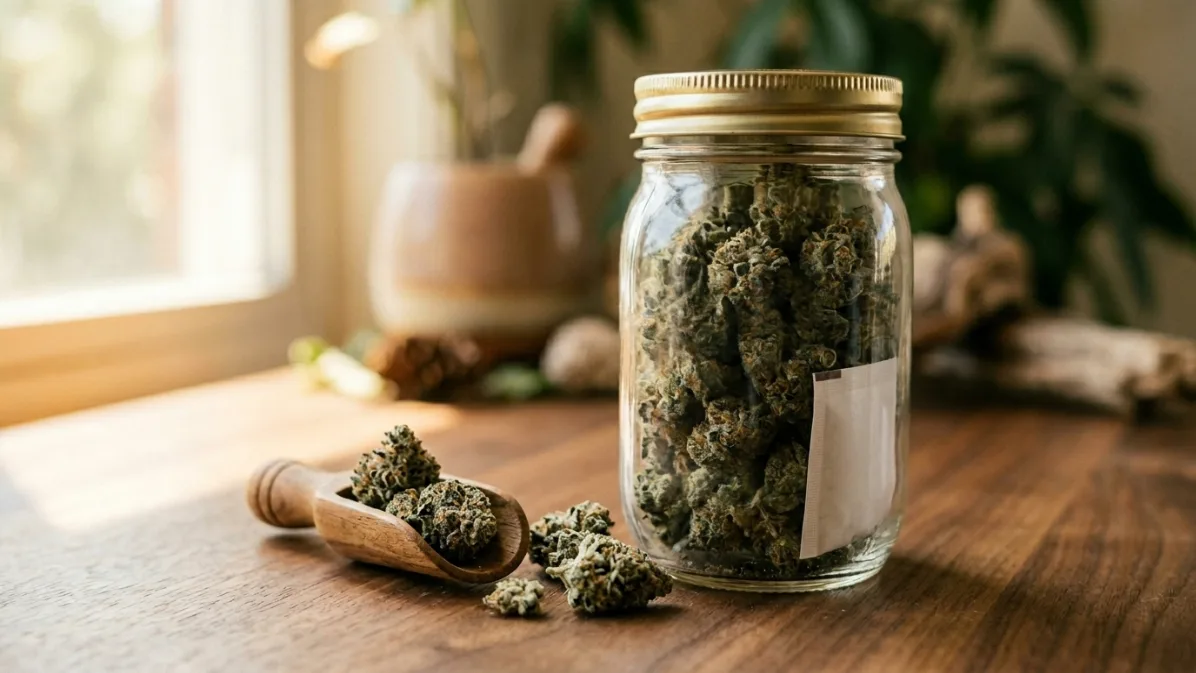
How to Store THC Flower: The 62% Humidity Rule, the Five Enemies of Cannabis, and Why Your Mason Jar Beats Every Plastic Bag
Cannabis is alive in storage. Cured properly and kept in the right conditions, it improves for weeks and stays peak for months. Stored wrong, it goes brittle, loses potency, molds, or dries to dust. Here's the protocol that keeps every jar in the cabinet at its best.
Cannabis isn't an inert product after harvest. It's a botanical material — a complex mix of cannabinoids, terpenes, and plant tissue — that continues to interact with its environment in storage. Stored properly, it stays at peak quality for a year or more. Stored carelessly in a ziploc bag in a kitchen drawer, it can degrade noticeably within a single month.
The good news: storing flower well isn't complicated. Glass jar, 62% humidity pack, dark and cool location, don't touch it more than you have to. Five rules. The rest of this guide explains why each rule matters and how the storage habits compound over the months you'd actually keep a stash.
The Five Enemies of Cured Cannabis
1. Excess Humidity — The Mold Risk
Mold is the single 'truly bad' storage outcome. Above 65% relative humidity, mold spores already on the flower can germinate. Visible mold (fuzzy white or grey patches, a sour or ammonia smell, a powdery texture on bud surfaces) means the entire jar should be discarded — smoking moldy flower is associated with respiratory infections and is genuinely dangerous, especially for immunocompromised people.
2. Insufficient Humidity — The Crumble
Below 55% relative humidity, the trichome heads (where the cannabinoids and terpenes live) become brittle. The flower turns 'dusty' — gentle handling breaks off the resin glands and they end up at the bottom of the jar as kief. The flower also loses its bouquet — terpenes volatilize faster from dry plant matter than from properly hydrated material.
3. Light — Especially UV
Light degrades cannabinoids. UV light degrades them fastest. A 1976 stability study found that exposure to light is the single largest factor in THC degradation over time. Direct sunlight on a clear jar can cut potency meaningfully in weeks. Even ambient room light, over months, accumulates damage.
4. Heat
Heat accelerates every degradation pathway — cannabinoid oxidation, terpene volatilization, moisture migration. Room temperature is fine; anything warmer than 70°F shortens shelf life. Storing cannabis near a stove, a sunny windowsill, or a heating vent is asking for accelerated degradation.
5. Air (Oxygen)
Oxygen oxidizes THC into CBN over time. CBN is sedating and not generally considered a 'good' transformation — old flower that's been exposed to air develops a heavier, drowsier high and a flatter flavor. Sealed glass minimizes oxygen exposure between sessions; opening the jar daily for a year accelerates the process.
Humidity at 62%. Glass jar. Dark cabinet. Cool. Don't open more than you need to. Five rules. Master them and your flower stays peak for a year — easily long enough to never matter.
The Right Container — Glass Wins
Glass Mason Jars
The classic and the best: a wide-mouth mason jar with a two-piece lid. Glass is non-reactive, airtight when sealed properly, and doesn't generate static. Wide-mouth jars let you reach in without crushing the buds. Wide-mouth pint (16 oz) holds about 1 oz of flower; quart (32 oz) holds about 2 oz.
UV-Tinted Glass Jars
Amber or violet UV-blocking glass is the upgrade. Same airtight seal as clear glass, with the added benefit of filtering out the light wavelengths that degrade cannabinoids fastest. Worth the small premium for long-term storage.
Metal Tins
Acceptable for short-term but not long-term storage. Metal can react with terpenes and impart a metallic taste over months. Aluminum tins are worse than steel. Glass is always better.
Plastic — Avoid
Plastic generates static, which pulls trichome heads off the flower onto the container walls — you're literally losing potency to the bag. Most plastics also off-gas chemicals into the flower over time. Use plastic only for short trips (a few days at most) and only in non-static-prone polypropylene or polyethylene containers, not common ziploc bags.
Vacuum-Sealed — Mixed
Vacuum sealing eliminates oxygen, which slows oxidation. But the pressure crushes the trichomes against the bag, and the bag itself is plastic. Vacuum sealing is useful for very long-term storage (>6 months) but not for jars you'll open frequently.
The 62% Humidity Rule
Cannabis preservation has a clear consensus humidity range: 58–62% relative humidity inside the container. The standard target is 62%.
Why 62% Specifically
It's the upper bound where mold risk stays minimal while preserving the natural moisture content of properly cured flower. Below 60% and trichomes start drying out and crumbling. Above 65% and mold becomes a meaningful risk. 62% threads the needle.
Humidity Packs — Boveda, Integra Boost
Two-way humidity packs solve the entire humidity problem automatically. They contain a saturated salt solution that absorbs moisture when humidity is too high and releases it when too low — passively holding the container at the target percentage. Drop one in each jar, replace every 2–3 months when the pack feels stiff.
Pack sizes. 8g packs for jars holding up to 1 oz of flower. 60g packs for larger storage containers.
Other targets. Some users prefer 58% for a slightly drier smoke. 65% packs exist but are too humid for safe long-term storage in our opinion.
Brands. Boveda and Integra Boost are the two reliable brands. Both work the same.
Temperature and Location
Aim for 65–70°F — standard room temperature. Some specific guidance:
Cabinet or drawer in a temperature-stable room. Bedroom or interior closet is ideal.
Avoid: kitchen. Kitchen temperatures swing widely from stove heat, dishwasher heat, oven heat. Bad environment for flower.
Avoid: bathroom. Shower humidity spikes throw off the humidity inside the jar even when sealed.
Avoid: garage / attic. Wild temperature swings. Bad.
Avoid: refrigerator. Refrigerator humidity is too dry (most fridges run at 30–40%). The repeated temperature swings as the fridge cycles also cause moisture to migrate inside the jar. Mold risk increases.
Freezer — only for long-term archival. Freezing preserves cannabinoids well but makes trichomes brittle — handling frozen flower knocks off potency. Use only for flower you won't touch for 3+ months. Thaw to room temperature inside the sealed container before opening.
The Daily Habits That Compound
Open the Jar Briefly
Every time the jar opens, fresh oxygen enters and humid air leaves. Open, take out what you need, close. Don't leave it open while you grind or roll.
Don't Touch the Flower Excessively
Fingers knock trichome heads off the flower onto your skin. Use tweezers or a glass scoop if you're particular. Most users find clean hands acceptable but the principle holds.
Don't Grind in Advance
Ground flower oxidizes much faster than whole bud — exposed surface area is 100× higher. Grind only what you'll use in the current session.
One Jar Per Strain
Mixing strains lets terpene profiles cross-contaminate. After a few weeks, your three strains all start smelling like the loudest one. Separate jars keep each strain's profile intact.
Label and Date
Tape a strain name and a 'jarred' date on each lid. You'll thank yourself in three months when you can't remember which jar is which.
How Long Does Flower Actually Last?
Improper Storage (Plastic Bag, Drawer, Room Light)
4–8 weeks until noticeable degradation. Terpene flavor flattens first, then potency drops, then trichomes crumble. By month 3, the flower is significantly degraded but still usable.
Glass Jar, No Humidity Pack, Cabinet
3–6 months at peak quality. Will eventually dry out or, if the environment is humid, develop mold spots.
Glass Jar + 62% Boveda + Cabinet (Standard Protocol)
12–18 months at peak quality. Beyond that, slow potency decline (~5–10% THC loss per year) but still usable for years.
UV Glass + 62% Boveda + Cool Dark Cabinet
18–24 months at peak. The UV-blocking glass meaningfully extends the timeline.
Vacuum Sealed + Frozen
Multi-year preservation. Most stable for long-term storage but limited usability — you can't open and reseal repeatedly.
Spotting Mold Early
Mold is the one storage failure mode that matters for safety. Inspect any jar that's been sitting for weeks. Signs:
Fuzzy white or grey patches on bud surfaces (NOT to be confused with trichomes — trichomes are crystalline, mold is fuzzy).
Powdery white residue that looks unlike trichomes (mold powder mixes inhomogeneously through the bud; trichomes coat surfaces evenly).
Sour, musty, or ammonia smell. Healthy cured cannabis smells terpene-rich and herbal — never sour.
Visible cobweb-like fibers between bud sections.
Discoloration in patches — brown spots, dark bruising — not consistent with strain pigmentation.
If you suspect mold, do not smoke the flower. Inhaling mold spores can cause serious respiratory infections, especially in immunocompromised users. Discard the affected jar.
The Five-Minute Storage Setup
Everything you actually need to do, in five minutes:
Buy or grab a wide-mouth glass mason jar.
Drop one 8g Boveda 62% humidity pack in the jar.
Add your flower — fill jar 2/3 full at most, leaving air space for the humidity pack to work.
Seal the lid tight.
Label the jar with strain name and date. Put it in a dark drawer or cabinet at room temperature.
That's it. Replace the Boveda every 2–3 months when it feels stiff. The flower will stay at peak for a year.
Special Cases
Storing Pre-Rolls
Same protocol — glass tube with a Boveda mini-pack. Pre-rolls dry out faster than whole bud because they're already broken down. A 1g Boveda mini-pack inside a glass tube keeps them perfectly fresh for months.
Storing Concentrates
Different rules. Live rosin and live resin want cold and dark — refrigerator short-term, freezer long-term. Silicone or glass only — never plastic.
Storing Edibles
Treat like the non-cannabis version. Brownies room-temperature 3 days or refrigerated 1 week. Gummies refrigerated 2 weeks. Capsules cool and dark for 6 months. See the edibles guide for full storage timelines.
Where to Buy Fresh Flower
Storage technique matters more when you start with fresh material. Our Top Shelf Fresh Drops catalog rotates weekly — when you order, the flower in the box was packed within days, not months. Maximum runway for your storage protocol.
For bulk-buyers stocking longer-term, pound deals come vacuum-sealed for shipment but should be transferred to glass jars (with humidity packs) on arrival.
Related Reading
Best Tasting Exotic Strains — the terpene profiles you're protecting with good storage.
Indoor vs Greenhouse vs Outdoor — how growing environment affects shelf stability.
What Is Live Rosin? — the concentrate storage rules are different.
How To Roll a Joint — fresh flower rolls cleaner than dry flower.
Disclaimer: This article is for adults 21+ in states where hemp-derived THCa is legal. Inspect flower for mold before each use. If in doubt, throw it out. Cannabis affects individuals differently. Don't drive or operate machinery while under the effects of cannabis.
Keep reading & shop
The Best Humidity for THC Storage (And How to Keep It There)
How to Keep THC Flower Fresh in Summer Heat: The Storage Survival Guide
Shop: Shop THCa flower
What the writer recommends
6 hand-picked products
Further reading
Resources & References
Quick answers
Frequently asked
58–62% relative humidity is the consensus sweet spot. Below 55% and the trichomes get brittle and crumble. Above 65% and you risk mold. Boveda or Integra packs in the 62% target hold this range automatically.
Not in a 'spoiled food' sense, but yes — it degrades. Stored badly, flower loses 16% of its THC content per year. Stored properly, that drops to under 5% per year. Mold is the only true 'gone bad' risk, and it comes from too much humidity, not too little.
Properly stored (glass, 62% humidity, dark, cool): 12+ months at peak quality, with gradual potency loss after that. Improperly stored (plastic bag, room conditions, light exposure): 4–8 weeks before significant degradation.
Mixed. Freezing preserves cannabinoids well but makes trichomes brittle — handling frozen flower knocks the resin glands off. If freezing, use only for flower you won't touch for months and let it warm to room temperature before opening the container to avoid condensation.
Three reasons: (1) plastic generates static that pulls trichome heads off the flower onto the bag walls — you're losing potency to the bag. (2) Most plastics off-gas chemicals into the flower. (3) Plastic isn't airtight enough to maintain humidity. Use glass.
Keep reading
More from the editorial
Articles in How To and across the WHAM Read.
 How To5 min
Can I Buy Lil Baby's WHAM Weed Outside the US? How International Orders Work
Yes — WHAM ships Lil Baby's weed worldwide on personal orders. Message us through the contact page or site chat, get your total, and pay with Bitcoin from Binance, Trust Wallet, Coinbase or any wallet. Here's how international orders work, step by step.
 How To5 min
Why Does WHAM Take Bitcoin? Paying for Lil Baby's Weed With BTC
Paying for WHAM with Bitcoin takes 5% off your order, can't be frozen or blocked by any bank or app, and works from any platform — Cash App, Coinbase, Binance, Trust Wallet, PayPal, Venmo or any wallet — as long as you send to the address WHAM gives you.
How To3 minWhere Can I Buy Lil Baby's WHAM Weed Near Me?
You can buy Lil Baby's WHAM weed from anywhere in the US: order at the official store, whamlilbaby.com, and it ships to all 50 states in 2–5 business days. WHAM also works through warehouses and distributors. Here's how to order the real thing.

Get 5% off + the best reads in your inbox
Join 50,000+ subscribers. One short editorial email a week — unsubscribe any time.
No spam · unsubscribe in one click